
Privacy and Sound Control for Glass Office Partitions: Frosted Film, Laminated Glass, and Acoustic Upgrades
You want the natural light and modern look of glass office partitions, but you're stuck on one question: what about privacy and noise?
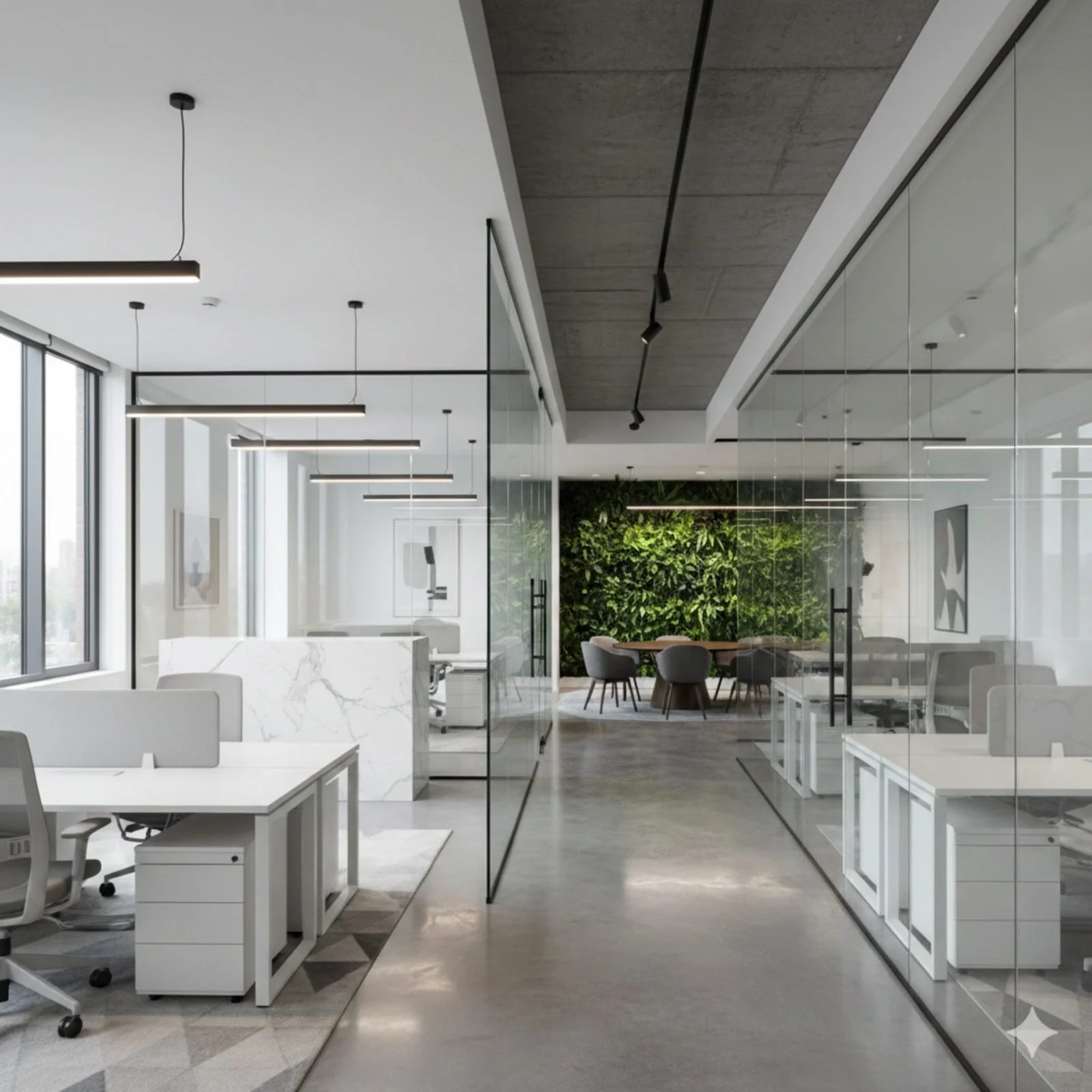
Custom frameless glass partitions designed for privacy, elegance, and seamless corporate interiors.
It's the number-one hesitation we hear from business owners, property managers, and general contractors across North Jersey. They love the idea of office glass partition systems that open up a floor plan and let daylight flow. But they need conference rooms where sensitive conversations stay private. They need private offices where employees can focus without hearing every phone call on the other side of the wall. And in medical settings, patient confidentiality isn't optional.
The good news: you don't have to choose between glass and privacy. The right combination of visual treatments and acoustic upgrades gives you both — and the solution depends on whether you need visual privacy, sound privacy, or both.
Quick Takeaways
Frosted film is the highest-ROI visual privacy upgrade, it blocks visibility while transmitting 70–85% of natural light, installs in hours, and costs a fraction of frosted glass replacement.
Laminated acoustic glass with a PVB interlayer adds 3–5 STC points over standard glass of the same thickness, bringing single-pane partitions into the STC 35–38 range.
Perimeter seals matter more than most people realize. Even an STC 50 glass panel can drop into the mid-30s if gaps around frames and doors aren't properly sealed.
Conference rooms typically need STC 40+ for speech privacy, while standard private offices can often work with STC 35–40 and frosted film at seated height.
Framed partition systems generally outperform frameless for sound control because the frame creates more opportunities for tight acoustic seals.
Do You Need Visual Privacy, Sound Privacy, or Both?
Before you spec any upgrades, start here: are you trying to block what people see, what people hear, or both?
Most people conflate the two and that's where projects get more expensive than they need to be. A frosted film that completely obscures visibility won't block a single decibel of sound. And a laminated acoustic glass panel that cuts noise by 35+ decibels won't prevent anyone from reading the whiteboard through clear glass.
For a standard private office where you just want to keep passersby from watching you work, visual privacy alone may be enough. For a conference room where you're discussing contracts, financials, or HR matters, you likely need both. And for medical suites handling patient information, a combination of visual obstruction and sound attenuation demonstrates the kind of "reasonable safeguards" that HIPAA guidelines reference.
Getting this right up front saves money and avoids rework. Here's how each solution stacks up.
Visual Privacy Options for Glass Office Partitions (Ranked by Cost and Permanence)
Frosted Film — Best ROI for Most Offices
If you're looking for the single most cost-effective visual privacy upgrade for existing glass partitions, frosted film is the answer. These polyester or vinyl films apply directly to your current glass surface and create the appearance of acid-etched or sandblasted glass, at a fraction of the cost of replacing panels.
Frosted film typically allows 70–85% of natural light to pass through while completely obscuring visibility from both sides. You can apply it full-panel for complete privacy, or use it selectively, frosted at seated height with clear glass above, for example — to maintain openness while keeping desk-level work hidden.
The practical advantages for North Jersey businesses are significant. Film installs in hours with zero construction dust or downtime. It's removable, so tenants in leased spaces can add privacy without permanent alterations. And you can incorporate logos, custom patterns, or gradient designs for branding.
Where we see frosted film used most: private offices, HR departments, reception partitions separating waiting areas from staff workstations, and any space where you want consistent day-and-night privacy without sacrificing light.
Acid-Etched and Sandblasted Frosted Glass
When you want a permanent frosted finish that's built into the glass itself, acid-etched or sandblasted panels are the premium option. The frosted effect is created by chemically treating or physically abrading the glass surface, producing a matte finish that won't peel, bubble, or degrade over time.
This is the right choice for long-term installations in spaces you own ( not lease) where the partition layout isn't likely to change. The finish feels more refined than film to the touch, and it holds up over decades with essentially zero maintenance beyond standard glass cleaning.
The tradeoff is cost and flexibility. Frosted glass panels cost substantially more per pane than film, and if your branding changes or you reconfigure the space, you're replacing glass rather than peeling off film.
Decorative Banding and Manifestation Strips
You don't always need full-panel frosting. In many offices, a frosted band applied at eye level or seated height provides enough visual privacy while maintaining the open, connected feeling that makes glass partitions appealing in the first place.
Banding typically runs 24 to 72 inches high and serves a dual purpose: it adds privacy for anyone seated inside the space, and it meets building code requirements for glass manifestation, the visible markings that prevent people from walking into clear glass panels. Custom designs, geometric patterns, and company logos are all common approaches.
This is the solution we recommend most often for open-plan offices where you want to define spaces without creating visual barriers, and for corridor-facing partitions where full frosting would make the hallway feel closed off.
Switchable Privacy Glass (Smart Glass) — The Premium Option
Switchable privacy glass uses PDLC (polymer-dispersed liquid crystal) technology to transition from clear to fully opaque at the flip of a switch. When powered on, the liquid crystals align and the glass is transparent. When powered off, they scatter, and the glass turns frosted.
This is the ideal solution for conference rooms that need to function as both open, visible collaboration spaces and fully private meeting rooms, sometimes within the same hour. The glass can also double as a projection surface when in its opaque state.
The cost is significant: switchable glass panels typically run $85–$150 per square foot, depending on size and specifications. For existing glass partitions, switchable PDLC film can be applied as a retrofit at $25–$40 per square foot — a more economical entry point that delivers the same on-demand privacy.
We've installed switchable glass in medical exam rooms in Wayne where the practice needed HIPAA-compliant privacy control without losing natural light — the staff simply switches the glass when patients are present.
Sound Control Options for Glass Partitions — What Actually Works
Visual privacy is straightforward. Sound control is where most projects go wrong — because the glass itself is only part of the equation.
Laminated Acoustic Glass
Laminated glass is the foundation of any serious sound-control strategy for glass partitions. It consists of two or more glass layers bonded with a polyvinyl butyral (PVB) interlayer that absorbs sound vibrations as they pass through.
The acoustic performance improvement is measurable. Laminated glass adds 3–5 STC points over non-laminated glass of the same thickness. In practice, this means a single-pane laminated partition can achieve STC 35–38, enough to reduce loud conversation to a low murmur on the other side. Double-glazed laminated systems, two laminated panes with an air gap push into the STC 42–50 range, which is comparable to a standard drywall partition.
For offices that need moderate sound control, a single pane of laminated tempered and laminated safety glass often does the job. For conference rooms, legal offices, or medical suites where speech privacy is critical, double-glazed laminated panels are worth the investment.
One important detail: using dissimilar glass thicknesses in a double-glazed assembly improves acoustic performance. When both panes are the same thickness, their resonance frequencies match, allowing more sound to pass through at those specific frequencies. Mixing thicknesses.Say, 1/4-inch and 3/8-inch, disrupts this resonance effect.
Perimeter Seals and Door Sweeps
Here's the factor that separates a well-performing glass partition from one that disappoints: where air goes, sound goes.
Even a partition built with STC 50-rated glass can drop into the mid-30s if the perimeter isn't properly sealed. Sound takes the path of least resistance, and it will find every gap — between the glass and the frame, under the door, above the partition if it doesn't run full height to the deck, and through HVAC ductwork that connects adjacent rooms.
As acoustic consultant Kevin Packer of FFA Consultants has noted, even small junctions that aren't well sealed allow noise to flank around the partition, negating the value of high-STC glass.
The fixes are straightforward but must be specified from the start: acoustic gaskets at every glass-to-frame junction, door sweeps or drop seals on every door, and continuous perimeter sealing at the head and base of the partition. For critical spaces, the ceiling plenum above the partition may also need treatment to prevent sound from traveling over the top.
Framed vs. Frameless — Where Each Wins for Sound
This is one of the most common design decisions for glass partitions, and it directly affects acoustic performance.
Framed partition systems, where aluminum or steel framing surrounds each glass panel; generally provide better sound control out of the box. The frame creates continuous contact points for acoustic seals, and the structural support allows for tighter tolerances between panels. For offices, medical facilities, legal practices, and any space where sound privacy is a priority, framed systems are typically the safer specification.
Frameless systems deliver a cleaner, more contemporary aesthetic with minimal visible hardware. They can still achieve good acoustic performance; frameless partitions with 12mm+ laminated glass and upgraded seals can reach effective noise reduction levels suitable for many office environments. But they require more precise installation, and the fewer contact points for seals mean there's less margin for error.
The practical takeaway: if the room's primary purpose demands sound privacy (conference rooms, executive offices, therapy rooms), lean toward framed. If aesthetics are the priority and moderate sound control is acceptable (creative studios, open-plan dividers, reception areas), frameless with acoustic upgrades can work well.
Why Sliding Doors Can Be Noisier — and How to Fix It
Sliding doors are increasingly popular in glass partition systems because they save floor space and look sleek. But they're also the most common weak point for sound in an otherwise well-performing partition.
The challenge is sealing. A hinged door compresses against a frame and gasket when closed, creating a relatively tight seal on all four sides. A sliding door rides on a track and has inherent gaps — particularly at the bottom edge and where the door panel meets the adjacent fixed panel.
The solutions exist, but they need to be specified: acoustic-rated sliding systems with integrated slam posts and vertical seal channels, bottom drop seals that engage when the door is closed, and upgraded gaskets at the leading and trailing edges. These upgrades can significantly close the performance gap between sliding and hinged doors, but they add cost and should be planned from the beginning , not retrofitted after noise complaints start.
Conference Rooms vs. Private Offices vs. Medical Suites — Different Needs, Different Specs
Not every room needs the same level of privacy treatment. Matching the specification to the room's actual function keeps costs reasonable while delivering the performance that matters.
Conference rooms are where most businesses need the strongest combination of visual and sound privacy. Target STC 40–45 for these spaces. Double-glazed laminated glass with framed partitions and acoustic-sealed doors is the standard approach. Switchable privacy glass adds the flexibility to keep the room visually open when not in use for sensitive meetings.
Private offices can often achieve adequate privacy with a more moderate approach. Single-pane laminated glass (STC 35–38) combined with frosted film or banding at seated height handles the majority of standard office needs, enough to muffle conversations to the point where words aren't distinguishable, with visual screening at desk level.
Medical suites require special attention. While the HHS Privacy Rule doesn't mandate soundproof walls, it does require covered entities to implement "appropriate administrative, technical, and physical safeguards" to protect patient information. In practice, this means the combination of visual obstruction (frosted glass or switchable glass for exam and consultation rooms) plus acoustic treatment (laminated glass, sealed partitions) demonstrates good-faith HIPAA compliance. For exam rooms, we typically recommend frosted or switchable glass with STC 40+ partition assemblies. Administrative areas can often work with frosted film on standard partitions.
How North Jersey Offices Are Using These Solutions
The privacy and sound challenges vary across our glass installations in Hudson County and Bergen County glass services service areas; and the solutions reflect local conditions.
Hudson County tight footprints.In Hoboken, Jersey City, and the waterfront corridor, office spaces tend to be compact. Every square foot matters, and traditional drywall partitions eat into usable space. We installed a demountable glass partition system with STC 45-rated laminated panels for a 50-person tech company in Hoboken — eight flexible meeting spaces and phone booths, all with acoustic-sealed sliding doors. The result: noise complaints dropped by 90%, and the team completed the installation over a single weekend with zero business disruption.
Bergen County medical suites. For a multi-physician practice in Wayne that needed to meet HIPAA privacy requirements without losing natural light, we installed switchable smart glass partitions in exam rooms and traditional frosted glass for administrative areas. Patients control their own privacy, staff switch the glass when patients are present — and the practice achieved full compliance while maintaining a modern, welcoming environment.
Paramus law firm privacy upgrade. A mid-size law firm needed to balance client confidentiality with an open, professional feel. We used frosted glass at seated height with clear glass above for the open office areas, then specified full-height laminated soundproof glass for the conference rooms. The result: natural daylight reaches every desk, clients feel confident in meeting privacy, and satisfaction scores improved.
How Much Does Frosted Film Cost Compared to Frosted Glass?
This is one of the first questions we hear, and the difference is significant. Frosted film costs a fraction of what you'd pay for acid-etched or sandblasted frosted glass panels. A frosted glass panel that might run over a thousand dollars can be achieved with film for a small fraction of that cost.
Beyond the price difference, film installs in hours (not days), doesn't require removing existing glass, and can be replaced or updated if your branding or layout changes. For tenants in leased spaces, film is almost always the right call because it's removable without damaging the glass.
Frosted glass makes sense when you're building new, want the tactile quality of a permanently frosted surface, and plan to keep the partition layout for years. For most retrofit projects and budget-conscious installations, film delivers the same visual result at substantially lower cost.
What STC Rating Do I Need for a Private Office or Conference Room?
The answer depends on what happens inside the room and how much ambient noise exists outside it:
STC 30–35 (standard single-pane glass): Loud speech is audible but not easily understood. Suitable for open-plan dividers and areas where visual separation matters more than sound privacy.
STC 35–40 (single-pane laminated glass): Normal conversation is reduced to a low murmur. Appropriate for most private offices, HR rooms, and manager offices where moderate speech privacy is needed.
STC 40–45 (double-glazed or double-glazed laminated glass): Speech is generally inaudible under normal conditions. This is the recommended range for conference rooms, legal offices, and financial advisory spaces.
STC 45+ (specialized acoustic assemblies): Near-complete speech privacy. Required for medical exam rooms, therapy offices, executive boardrooms, and any space where confidential information is regularly discussed.
Remember: these ratings apply to the entire partition assembly glass, frame, seals, and doors, not just the glass pane in isolation. A partition is only as quiet as its weakest point.
Conclusion
Privacy and noise don't have to be dealbreakers for glass office partitions. The right combination of visual treatments from cost-effective frosted film to on-demand switchable glass and acoustic upgrades like laminated glass, perimeter seals, and properly specified doors delivers the privacy your space needs without sacrificing the light, openness, and modern aesthetic that make glass the right choice.
The key is matching the solution to the room. Not every space needs STC 45 double-glazed laminated panels. And not every space can get by with a strip of frosted film. We help North Jersey businesses figure out exactly what each room requires, so you invest where it matters and save where you can.
Tell us your privacy goals and take two photos of the space — we'll recommend the right system. Call Delta Glass NJ at (201) 214-3779 for a free consultation, email us at deltaglassestimates@gmail.com, or contact us for a free consultation.